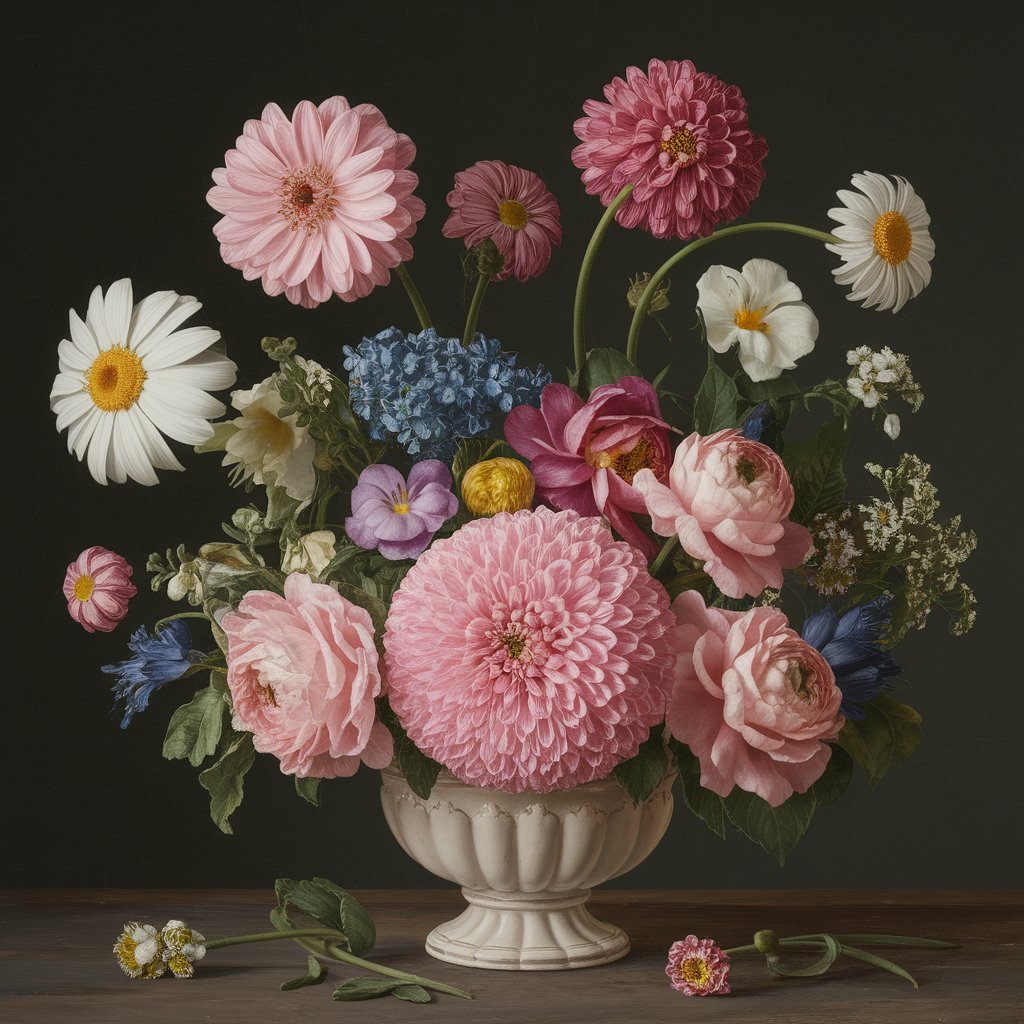

Fleurism is a distinctive form of floral art associated with the Georgian-Armenian filmmaker and artist Sergei Parajanov (Paradjanov). Unlike ordinary floristry, which generally focuses on arranging fresh flowers for decoration, fleurism is connected with the creation of artistic wreaths and compositions from dead or dried flowers.
The term is particularly associated with Parajanov’s years in a Soviet labor camp. According to a 1999 Guardian feature, Parajanov developed an art form he called “fleurism,” creating elaborate wreaths from dead flowers and involving fellow prisoners in making funeral wreaths.
This history gives fleurism a much deeper meaning than simple flower decoration. It connects beauty, mortality, memory, creativity, and human resilience. The use of flowers that have already passed their natural peak can transform something associated with death and decay into an object of artistic expression.
In 2026, the word can therefore be understood in a historical and artistic context rather than simply as another name for flower arranging.
Fleurism and the Difference Between Fleurism and Floristry
It is important to distinguish fleurism from floristry.
Floristry is officially described as the art or skill of a florist, and the word can also refer to the flower trade and professional flower arrangement.
Fleurism, by contrast, has a more unusual artistic association. Its best-known historical use relates to Parajanov’s artistic practice involving dead flowers and wreath-making.
The difference can be understood simply:
- Floristry focuses on arranging, selling, designing, and working with flowers.
- Fleurism is associated with an experimental and symbolic approach to flowers, particularly dead or dried floral material.
- Floristry is commonly connected with weddings, celebrations, decoration, events, and commercial flower design.
- Fleurism can communicate ideas about mortality, memory, suffering, beauty, and transformation.
This distinction is useful because the two terms sound similar but do not necessarily describe the same practice.
The Story of Sergei Parajanov and Fleurism
The history of fleurism is closely connected to Sergei Parajanov, an influential Soviet-era filmmaker and visual artist known for his highly distinctive artistic imagination.
During his imprisonment in a Soviet labor camp, Parajanov continued creating art despite extremely difficult circumstances. The Guardian reported that he invented fleurism during this period and made elaborate wreaths from dead flowers. He also taught other prisoners how to make funeral wreaths.
This background is important because it shows why fleurism can be interpreted as an example of creative resilience. Instead of treating discarded or dead natural material as worthless, Parajanov transformed it into something visually meaningful.
His artistic activity was not limited to flowers. The same account notes that he created thousands of artworks using whatever materials were available to him, including scraps of cloth and roofing tar.
Fleurism therefore fits into a much larger picture of Parajanov’s approach to art: finding artistic possibilities in ordinary, unwanted, or unexpected materials.
Fleurism, Flowers, and the Symbolism of Mortality
Flowers have always had an unusual relationship with human ideas about life and death. A flower can represent youth, beauty, love, celebration, renewal, or spiritual meaning. Yet flowers are also temporary. They bloom, fade, dry, and eventually disappear.
That natural cycle makes flowers powerful artistic symbols.
The historical language of flowers, often called floriography, demonstrates how people have used flowers to communicate ideas and emotions. The Royal Horticultural Society explains that during the 19th century, lovers and suitors used flowers to send coded messages, with individual flowers assigned particular meanings.
The tradition became especially popular from approximately the 1820s to the 1880s, with books providing extensive lists of floral meanings. Charlotte de la Tour’s 1819 Le langage des fleurs was an influential early publication and presented around 300 meanings for different flowers.
Fleurism can be considered within this broader history of floral symbolism, but its emphasis on dead flowers and wreaths gives it a darker and more reflective character.
A living flower can suggest new beginnings. A dried or dead flower can suggest memory, loss, time, or the continuation of beauty after life has ended.
How Fleurism Connects Art, Nature, and Creativity
One of the most interesting aspects of fleurism is the way it changes our perception of natural materials.
A dead flower is normally viewed as something that has reached the end of its useful decorative life. In an artistic context, however, it can become a raw material.
This idea is also found throughout the wider history of floral art. Flowers have appeared in paintings, sculpture, decorative arts, religious imagery, and contemporary installations. Floral symbolism can communicate emotions and concepts rather than functioning only as decoration.
Modern floral art can similarly treat flowers as an expressive medium, using composition, color, shape, texture, and symbolism to create a particular emotional response.
Fleurism is particularly interesting because it embraces the temporary and imperfect nature of flowers. Instead of hiding decay, the artistic process can make it part of the composition.
That makes fleurism relevant to contemporary conversations about sustainability, natural materials, recycling, impermanence, and experimental art.
Fleurism in the Context of Floral Art in 2026
The broader world of floral art continues to evolve. Flowers are no longer restricted to traditional bouquets and vases. Artists can use botanical materials in installations, photography, sculpture, fashion, performance, and conceptual art.
Contemporary floral movements also demonstrate that flowers can be the central subject of an artwork, rather than merely an ornamental detail. Academic research into floral art, for example, has examined contemporary movements such as Florescencism, which places flowers at the center of artistic and conceptual investigation.
This makes fleurism particularly interesting for modern audiences.
Its historical connection to Parajanov shows how floral material can become a medium for personal expression under extreme circumstances. At the same time, its focus on dead flowers gives viewers an opportunity to think about the relationship between beauty and impermanence.
In an era when artists increasingly experiment with recycled, organic, and temporary materials, the underlying idea behind fleurism remains surprisingly relevant.
Why Fleurism Is Still Interesting Today
The lasting appeal of fleurism comes from its combination of simplicity and depth. At first glance, it may appear to be about flowers and wreaths. At a deeper level, it raises questions about what happens to beauty when something begins to decay.
It also demonstrates that art does not always require expensive materials or ideal conditions. Parajanov’s story shows how creativity can survive even when resources are severely limited.
For people interested in floral art, botanical symbolism, contemporary art, Soviet cultural history, or Sergei Parajanov, fleurism offers an unusual point where these subjects meet.
It also encourages a different way of looking at natural materials. Instead of seeing a dried flower as something useless, fleurism invites us to consider its texture, history, memory, and emotional value.
Frequently Asked Questions About Fleurism
What does fleurism mean?
Fleurism is a term associated especially with Sergei Parajanov’s artistic practice of creating elaborate wreaths and artworks from dead flowers during his imprisonment in a Soviet labor camp.
Is fleurism the same as floristry?
No. Floristry is the professional art, skill, and trade of working with flowers, while fleurism has a specific historical association with Parajanov and artistic compositions made from dead flowers.
Who is associated with fleurism?
The name is most strongly associated with Sergei Parajanov, the renowned filmmaker and visual artist.
Why are dead flowers important in fleurism?
Dead flowers can represent mortality, memory, change, and the temporary nature of beauty. Their use also turns discarded natural material into an artistic medium.
Is fleurism relevant in 2026?
Yes. Its ideas remain relevant to modern discussions of experimental floral art, natural materials, sustainability, symbolism, and impermanence.
Conclusion
Fleurism is much more than a variation of flower arranging. Its historical connection to Sergei Parajanov gives the term a powerful artistic identity built around dead flowers, wreaths, creativity, and resilience.
While traditional floristry celebrates flowers through professional arrangement and design, fleurism draws attention to another side of nature: decay, memory, transformation, and the persistence of beauty.
That combination makes fleurism an unusual but fascinating subject in 2026, especially for anyone exploring the relationship between flowers and art. Its central lesson is simple yet powerful: even materials that appear to have reached the end of their life can be transformed into something meaningful through human creativity and imagination.
